Women’s Way Grand Rapids
Public Space Activation
ABOUT THE PROJECT
The Women's Way alley activation initiative aspires to honor local women leaders in Grand Rapids' history, enhance Downtown alleyways and give people another reason to explore the Downtown neighborhoods.
Etta Smith Wilson Way
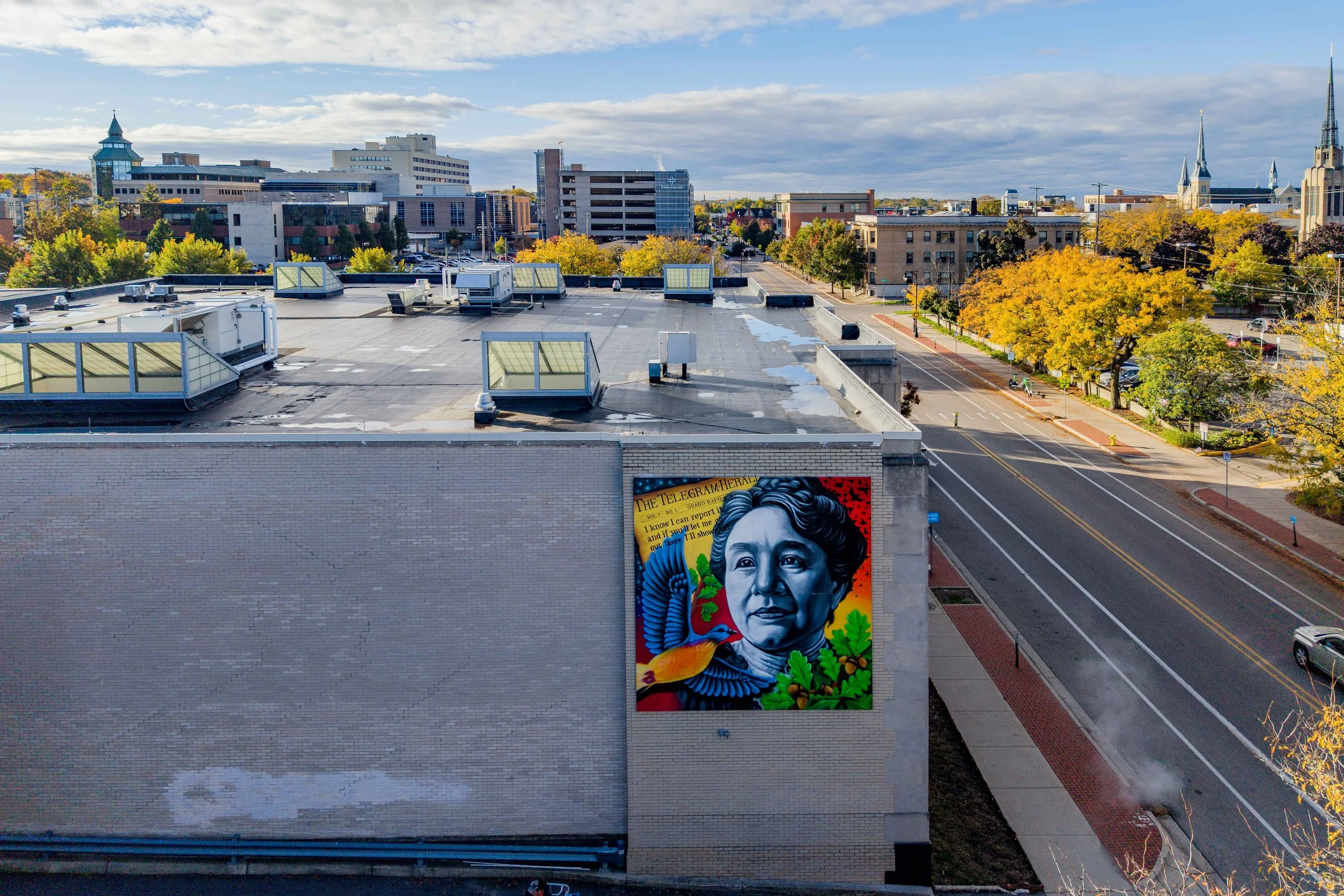
Located in the alley off Jefferson Ave. SE at the northwest corner of the Grand Rapids Public Museum School.
Etta Smith Wilson | 1857-1936
Etta was Grand Rapids’ first woman reporter and a pioneering naturalist whose life bridged Indigenous knowledge, formal education and early journalism. She went on to build an ambitious career in journalism, deliberately covering subjects typically reserved for men—including sports, business meetings, court proceedings and political affairs—making herself an indispensable figure in the newsroom.
For nearly three decades, she closely observed birds, documenting their behavior and advocating for their preservation. Her work reflects a rare and powerful synthesis of Indigenous ecological knowledge, journalistic inquiry, and early conservation efforts, securing her legacy as a trailblazer in both media and environmental awareness.
Statement by Artist Kevin Wolfrom
This mural is not just an image on a wall — it is a tribute to the life, determination and the legacy of Etta Smith Wilson, the first female reporter in Grand Rapids, Michigan. In this piece, I wanted to honor the key moments that shaped her journey, weaving together the chapters of her life into a single unified visual story. The message behind this mural is one of strength and self-determination: we are capable of transcending the limitations placed upon us — whether personal or societal. Etta reminds us to create our own path, pursue our passions boldly, and leave behind a legacy that inspires others to rise.
Grand Rapids Chicks Way

Located in the alley off Newberry St. NW behind Auto Fixit Body Shop.
Grand Rapids Chicks | 1945 – 1954
The All American Girls Professional Baseball League organized during World War II and fielded ten popular teams in the Midwest. The 600 women players suffered the rigors of the road as well as charm school, played in lipstick and slid into base in short skirts. The Grand Rapids Chicks played from 1945 to 1954, consistently appeared in the playoffs and won two championships. Their trading cards circulate again today because players, ignored by baseball history, took matters into their own hands and formed an association in the 1980s. Their efforts inspired the 1992 film A League of Their Own.
Statement by Artist Michi Farias
This team is a local example of women’s perseverance through the hardships of World War II. Their story is about pushing through societal expectations towards the women who pioneered all-female teams in sports. Young women and men need to see female athletes from the past as they were — pioneers in the realm of professional athleticism that pushed through the obstacles they faced.
Ethel Coe Way

Located in alley off Monroe Ave NW on the north side of GLC Live at 20 Monroe.
Ethel B. Coe | 1899-1988
Ethel B. Coe was born in Virginia in 1899 - 30 years after the Civil War - and moved to Grand Rapids at age eight. Coe won a civil rights case while attending South High School after she was refused service at a local ice cream parlor. Throughout her life, Coe was active in the NAACP, Urban League, Family Life Council and many other clubs. At the age of 68, Coe traveled the U.S. and abroad as a volunteer teaching English to Latino and Vietnamese children. She was also a singer and actress who performed for more than 40 years in venues like Civic Theatre and St. Cecilia Music Society.
Statement by Artist Esan Sommersell
This portrait, titled “The Amazing Coe,” represents the balance of society and creativity. As a sign of hope for all creators, the portrait serves as a beacon in the present and future times. This comic book technique shows Coe as the hero she is, and the descriptive words provide action, fitting her activist lifestyle.
Angeline Kelsey "Naw Kay o say" Yob Way

Located in the alley off Sheldon Blvd NE between the Grand Rapids Children’s Museum and The Apartment Lounge.
Angeline Kelsey "Naw Kay o say" Yob | 1924-2002
The descendant and ancestor of Chiefs, Angeline Kelsey “Naw Kay o say” Yob was an educator, community activist and citizen of the Grand River Bands of Ottawa Indians. She was the great-great-granddaughter of Chief Maish Ke Aw She, one of the signatories of the Treaty of 1855, which provided the terms for the removal of the Ottawa from the Grand River Valley.
Yob, at the age of five, experienced her own forced move to a Native American Boarding School. Still, she retained her native language and would go on to help lead the Native American Education Program at Grand Rapids Public Schools. For three decades, she used stories as teaching instruments to help students of Native American descent learn and grow in their traditions.
Statement by Artist Alan Compo
Angeline Kelsey Yob helped establish many of the first groups for the Grand Rapidian Native Americans. The turtle shows all the Grand River Bands of Ottawa Indians. The kids dancing represent the culture, and the knowledge that Angeline brought children. I placed her portrait within the medicine wheel because of the constant lessons within.
Maurilia Ortiz Blakely Way
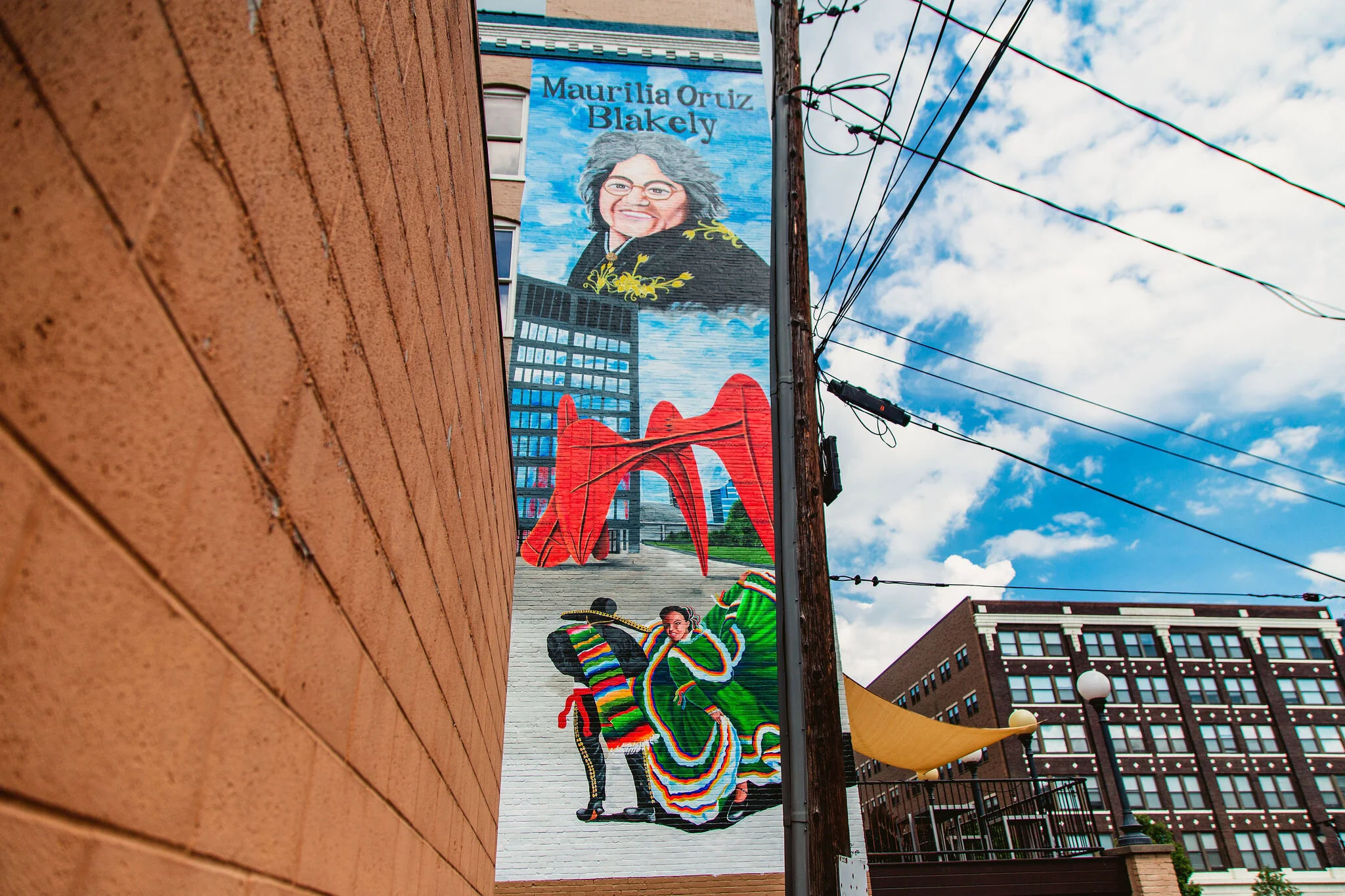
Located in the alley off Fulton St. W next to San Chez Bistro
Maurilia Ortiz Blakely | 1928 – 2015
Maurilia Ortiz Blakely was a role model, a champion for minority women’s rights, an activist for the poor and an advocate for higher education.
Orphaned at an early age, her maternal aunt raised her to have great respect for their Mexican heritage and to help the less fortunate. A divorced working mother of five, Blakely was a force in her community and helped organize Grand Rapids’ first Mexican Festival in 1970.
After graduating from college with a degree in Social Work at age 51, she assisted Latinx students, women, migrants, the homeless and the unemployed and helped to establish the Hispanic Institute. Among her many honors was a Grand Rapids Lifetime Achievement Award.
Statement by Artist Arturo Romero
This portrait of Maurilia “Molly” Ortiz Blakely intends to depict her strength as a woman, her humility and the pride she had for her culture, family and community. I was inspired by her ability to command respect while encouraging love as well as her perseverance to help others reach for the stars.
Harriet Woods Hill Way

Located in the alley off Louis St. NW at the northwest corner of the Grand Rapids Police Department.
Harriet Woods Hill | 1922-2006
In 1955, Harriet Woods Hill became the first African American female officer in the Grand Rapids Police Department. Her career began in the Juvenile Division, and she later trained new recruits about the challenges faced by children. Hill, in 1977, was named the first female detective in the department’s 106-year history. “I came there to do a job, and I wasn’t going to allow [anyone] to force me to quit working because [of their] prejudices,” she said. “Once the door was opened, I never allowed it to become closed.”
Statement by Artist Jasmine Bruce
Harriet Woods Hill was resilient and humble. Symbolism flows through this piece as waves pay ode to Harriet’s hometown leading to the old-time Grand Rapids cityscape. Lotus flowers symbolize her growth out of muddy waters, all the while soaring above.
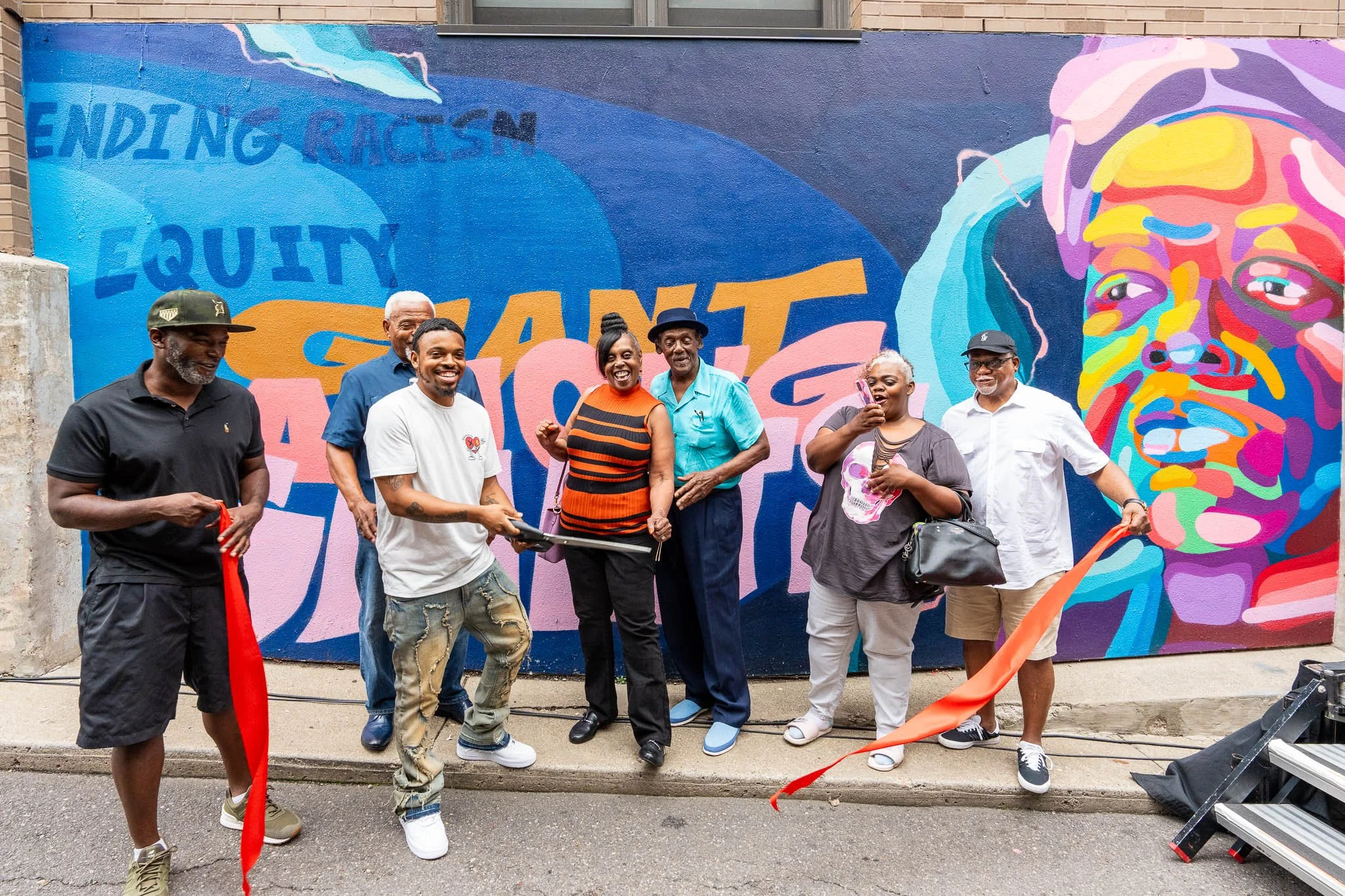
Dr. Ella Mary Sims Way
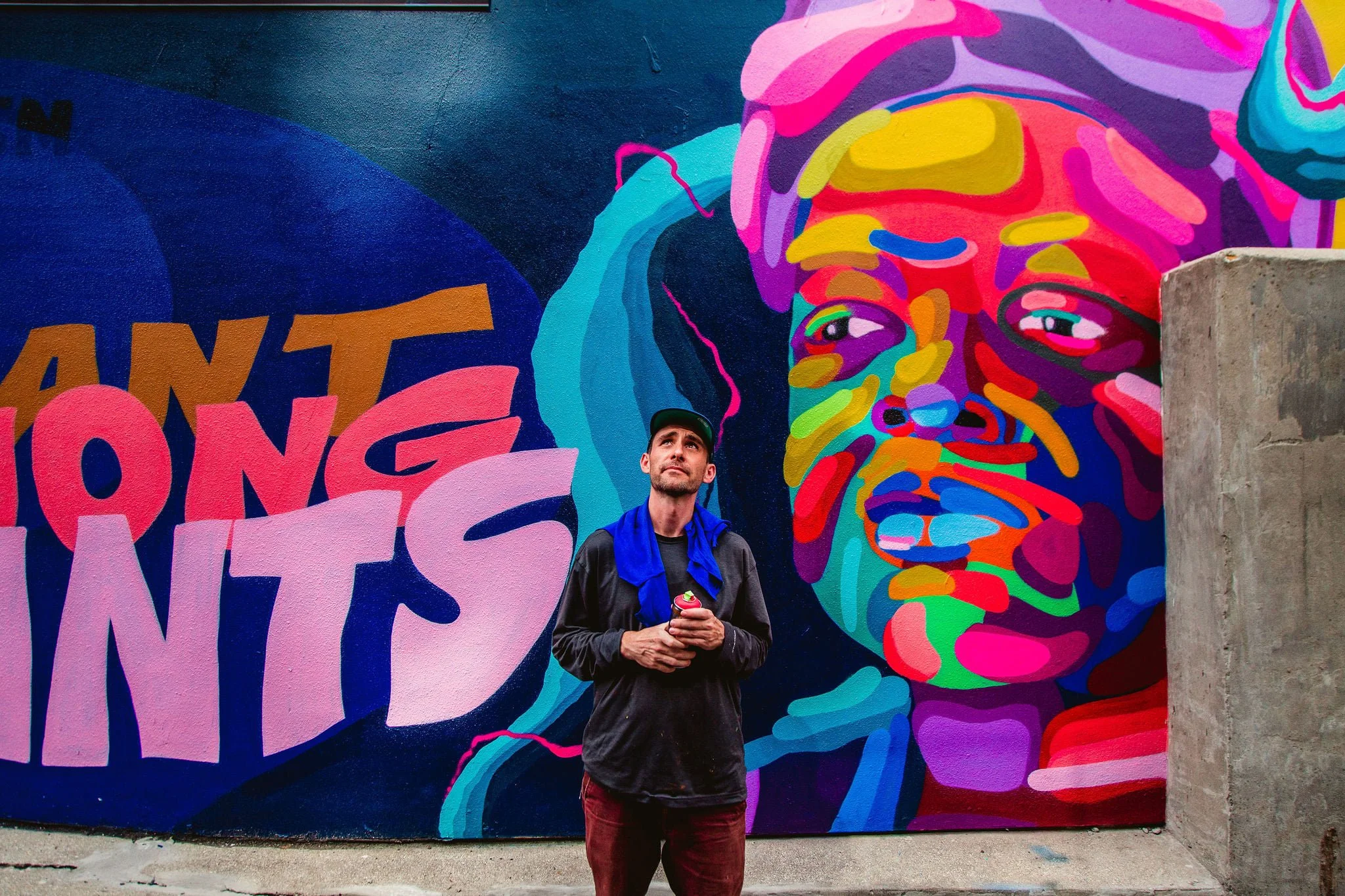
Located in the alley off Weston Street at the northeast corner of Weston Apartments.
Dr. Ella Mary Sims | 1924 - 2013
Dr. Ella Mary Sims was an exceptional member of the community, known for her unwavering activism and strong religious beliefs.
Her contributions to Grand Rapids were nothing short of remarkable, including helping establish the Women's Resource Center at the YWCA in 1973 and becoming the first woman of color to write a column for The Grand Rapids Press. Sims was a tireless advocate for many causes, notably securing federal funding for the Campau Commons public housing project. Her legacy will undoubtedly continue to inspire and serve as a shining example for generations to come.
Statement by Artist Dustin Hunt
Dr. Sims was persistent, committed, persuasive, and driven by her faith. A giant among giants, as she was recognized in 2005, among many other awards, for her achievements. Dr. Sims was involved with many organizations in Grand Rapids over the course of several decades. So, how does one depict her work in a single mural? I wove a colorful cloud through the entire piece, beginning in the fields of Mississippi near a sharecropper’s cabin where she spent her early years, up to a vibrant portrait of Dr. Sims in her later years. I chose to focus on a few key concepts. After learning of her involvement with the Grand Rapids Study Club, and their motto of “rowing not drifting”, I chose to include a row boat, surrounded by several ripples, signifying Dr. Sims’ far reaching impact in the community. Several people noted that most did not see Dr. Sims’ impact, but they surely felt it, even without knowing it. I wanted to emphasize persistence. I also embedded some of Dr.Sims’ characteristics I pulled from interviews and obituaries from friends and family. Another consideration for this piece is the placement. I chose design elements that run horizontal ie; the clouds, fields, and ripples, to draw the viewer’s eyes all the way down the alley-like driveway. I chose to work with a semi limited color palette for the three panels leading up to the portrait of Dr. Sims. This allows for the colors found within Dr. Sims portrait to pop and further draw viewers’ eyes and interest towards the right side of the mural.”
Alley Locations
Grand Rapids Public Museum School
54 Jefferson Ave SE, Grand Rapids, MI 49503
1: Etta Smith Wilson
Auto Fixit Shop
805 Ottawa Ave NW, Grand Rapids, MI 49503
2: Grand Rapids Chicks Way
GLC Live at 20 Monroe
11 Ottawa Ave NW, Grand Rapids, MI 49503
3: Ethel Coe Way
4: Angelina Kelsey “Naw Kay o Say” Yob Way
Children’s Museum
33 Sheldon Ave NE, Grand Rapids, MI 49503
San Chez
38 Fulton St W, Grand Rapids, MI 49503
5: Maurilia Ortiz Blakely Way
Grand Rapids Police Department
1 Monroe Center St NW, Grand Rapids, MI 49503
6: Harriet Woods Hill Way
Weston Apartments
21 Weston St SE, Grand Rapids, MI 49503
7: Dr. Ella Mary Sims Way
Organized By